Forklift Safety Rules in Singapore: What WSH Compliance Actually Requires
A forklift is the most useful machine in your warehouse. It is also the one most likely to put someone in hospital.
Between 2022 and 2023, vehicle crashes were the leading cause of fatal workplace injuries in Singapore, and roughly one in four of those vehicle deaths involved a forklift. MOM has responded with tighter training rules, and the deadline is coming fast.
Here is what the law actually requires from any Singapore business that runs a forklift, in plain English.
Rule 1: Only Certified Operators Behind the Wheel
Under section 31 of the Workplace Safety and Health Act, where the Minister has ordered a class of persons to attend a training course, the employer “must ensure that the person completes or has completed such safety and health training course before allowing that person to perform any work for which the training is required” (s.31(2)), and the course must be run by an accredited training provider (s.31(3)). An employer who breaches that duty commits an offence carrying a fine of up to $5,000, up to 6 months’ imprisonment, or both (s.31(5)). In practice that means the WSQ Operate Forklift course from an MOM-approved training provider.
The basics your operators must meet:
- Certification: a valid certificate from an MOM-approved training provider. A car or Class 3 licence alone does not count.
- Age: at least 18 years old.
- Fitness: no condition, such as defective sight or hearing, that makes safe operation impossible.
- Heavy trucks: operators of forklifts above 5 tonnes need additional heavy forklift training.
This applies on private premises too. Your yard, your warehouse, your rules? Not quite. The WSH Act still applies anywhere work is done.
Rule 2: The New 3-Yearly Refresher Requirement
This is the big change. In November 2024, MOM announced that all forklift operators must attend a refresher training course at least once every three years. Operators must be compliant before 1 January 2027.
Why the change? MOM inspections found that nearly 80 percent of forklift-related violations involved operators who had not refreshed their training within three years. Skills fade. Bad habits creep in. The refresher course covers updated industry guidelines, lessons from past accidents, and hands-on practice.
Rule 3: Daily Pre-Use Checks
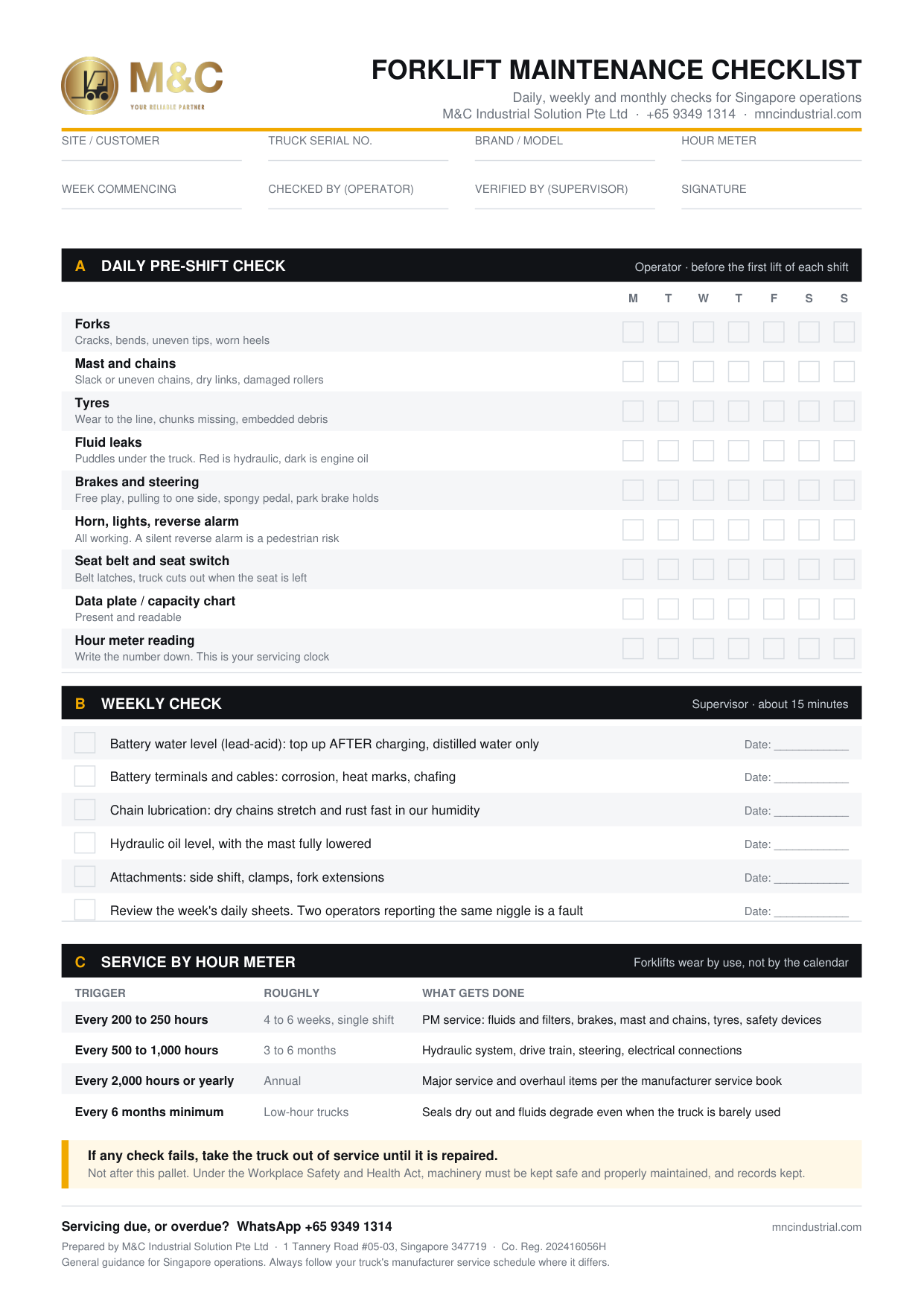
Singapore Standard SS 573 and the WSH Guidelines on Safe Operation of Forklift Trucks expect a documented inspection before each shift. A proper pre-use check takes under ten minutes:
- Tyres, wheels and forks for damage or cracks
- Hydraulics for leaks, mast operation through full range
- Brakes, steering and horn
- Seat belt and overhead guard condition
- Battery charge and connections on electric trucks
- Lights, reverse alarm and any attachments
Keep the completed checklists. If MOM inspects after an incident, a stack of signed daily checks is the difference between a routine visit and a very bad month. Faults found during checks should go straight to your service provider. If your trucks are under our care, see how our aftersales servicing handles this.
Rule 4: Manage the Traffic, Not Just the Truck
Most forklift accidents are not exotic. A pedestrian steps out of a blind aisle. A truck reverses into a picker. The WSH guidelines expect workplaces to plan for this:
- Segregate: marked pedestrian walkways, physical barriers where possible, and designated crossing points.
- Slow down: site speed limits, enforced. Speed control devices help where discipline does not.
- See and be seen: blue spot warning lights, red zone lights and reverse cameras cut blind spot incidents dramatically. We fit these as safety accessories on rental and customer trucks alike.
- Load discipline: never exceed rated capacity, keep loads low when travelling, no passengers, ever.
Narrow aisle operations deserve special mention. Guided VNA trucks actually reduce traffic risk because the truck cannot wander within the aisle. More on that in our VNA vs reach truck guide.
The daily check, on one page
Rule 3 above is the one that gets skipped, because nobody has a sheet to write it on. Here is ours, free, with a column for each day of the week.
What Non-Compliance Costs
The WSH Act does not do small fines. Here are the maximum penalties:
| Offence | Maximum penalty |
|---|---|
| Company breaches WSH Act (first offence) | $500,000 fine |
| Company, repeat offence | $1,000,000 fine |
| Individual breaches WSH Act (first offence) | $200,000 fine and/or 2 years' jail |
| Ignoring a Stop Work Order | $500,000 fine plus $20,000 per day it continues |
And that is before the real costs: an injured worker, a stopped operation, higher insurance and a reputation problem with every customer who audits your site.
How Renting Helps You Stay Compliant
A surprising number of WSH findings trace back to poorly maintained trucks: worn brakes, bald tyres, dead horns. Owning an ageing forklift means owning its maintenance discipline too.
Renting shifts that burden. With an M&C rental, servicing and breakdown response are on us, so the truck that turns up for work each day is one we keep roadworthy. Typical rates are on our forklift rental Singapore page.
We are bizSAFE 3 certified ourselves, and our fleet includes electric Zowell trucks with modern safety features as standard. We can also retrofit AI cameras, laser fork positioning, blue spot lights and speed control to trucks you already own.
What an inspection actually looks at
The rules above are what the law asks for. What an inspector looks at on the day is a shorter and more practical list, and after the 2026 Safety Time-Out the penalties behind it got heavier. We set it out in what MOM looks at when it inspects your forklift.
If anything is fitted to the truck
Attachments are their own compliance question and a common source of findings. See forklift attachments in Singapore.
The fuel, not just the truck
Operator rules cover the machine. The diesel that feeds it is regulated separately, by SCDF rather than MOM. See storing diesel inside your warehouse: what MOM expects
Common Questions
Do I need a licence to drive a forklift on private property in Singapore?
You need the WSQ Operate Forklift certificate wherever the forklift is used for work, including private premises. A traffic Class 3 licence is only relevant if the forklift goes on public roads.
When is the refresher training deadline?
Operators must have attended refresher training before 1 January 2027, and at least every three years after that.
Who is liable if an uncertified operator has an accident?
Both the operator and the company can be prosecuted under the WSH Act. Directors and managers can be personally liable if the lapse was within their control.
Does a rented forklift still need daily checks?
Yes. Daily pre-use checks are the operator's duty regardless of who owns the truck. Servicing and repairs, though, are ours.
The Bottom Line
Forklift compliance in Singapore comes down to four habits: certified operators, refresher training every three years, daily checks and sensible traffic management. None of it is expensive next to a $500,000 fine or a serious injury.
Not sure if your fleet or your paperwork would pass an inspection? Ask us. We look at trucks, racking and safety accessories every day, and a quick site visit costs you nothing.
Safety equipment we fit
Beyond training and checks, these are the physical safety and productivity add-ons we fit to forklifts and warehouses in Singapore:
- AI Camera & Recording: detects people in blind spots and logs every journey.
- Blue & Red Zone Lights: warns pedestrians before the truck arrives.
- Laser Fork Positioning: shows exactly where the fork tips are before you lift.
- Weighing Fork: shows the exact load weight before you lift.
- Keyless System (Safety T-Lock): controls who can drive and logs who did.
- Seat Belt System: keeps the operator in the cage if the truck tips.
- Flexible Polymer Safety Barrier: rated to absorb a forklift impact and flex back.
- Automatic Fire Extinguisher: detects and suppresses a fire at an unattended charging bay.
Sources
Every figure and legal duty on this page comes from a published government source. Read them yourself:
- Workplace Safety and Health Act 2006 — Singapore Statutes Online, Attorney-General’s Chambers. Section 31: training courses, the employer’s duty before allowing work, and the $5,000 penalty. Read 30 August 2026.
- MOM press release, “Enhanced forklift operator refresher training course and new refresher training requirement”, 6 November 2024 — the source of the two statistics on this page: vehicular incidents were the leading cause of fatal workplace injuries from 2022 to 2023, “1 in 4 of these vehicular fatalities involved forklifts”, and MOM’s inspections found “close to 8 in 10 forklift-related contraventions involved forklift operators who had not undergone forklift refresher training within three years”.
- MOM Circular MOM/OSHD/2025-01, “Mandating Forklift Operator Refresher Training Course”, 3 January 2025 (PDF) — the 1 January 2027 date and the three-year interval.
- WSH Council Guidelines on Safe Operation of Forklift Trucks (PDF) — the daily pre-use check and pedestrian segregation practice.
This page explains what the published sources say. It is not legal advice, and where your situation turns on a detail you should check with the authority named or your own adviser.
Related reading
- Forklift risk assessment: the legal duties, the two 3-year rules, and why PPE comes last.
- Slinging a load from forklift forks: MOM's seven criteria, and the Authorised Examiner claim most suppliers get wrong.
- Forklift refresher training: the MOM rule from January 2027.
- Forklift maintenance checklist: the daily checks that prevent incidents.
- Forklift servicing Singapore: keeping trucks safe and compliant.
Free safety and fleet check. Zero pressure.
Tell us what trucks you run. We reply same day with practical next steps.
WhatsApp +65 9349 1314 Get a Free Quote