Who Can Service My Forklift in Singapore When the Dealer Will Not?
You bought the truck second-hand, or from a different agent, and now the brand's dealer will not touch it. That is normal in Singapore, it is not a legal problem, and it has a straightforward answer.
The short version
- Nothing in Singapore law ties a forklift to the company that sold it. Any competent servicing company may maintain it.
- Brand dealers generally work only on their own machines. That is a commercial choice, not a rule.
- A forklift is not statutory lifting equipment, so it does not need an Authorised Examiner the way a crane does — unless you use it to lift a slung load.
- What decides whether an independent can really service your truck is boring and specific: parts, fault codes, and the manual for your exact model.
Why the dealer says no
Forklift brands in Singapore mostly sell through a single appointed agent. That agent's service department exists to protect the machines it sold and the parts margin that comes with them. A truck bought from an auction, imported directly, or inherited with a warehouse lease sits outside that arrangement, so the agent has little reason to take it on — and often quotes a price that politely says no.
This is why almost every mixed fleet in Singapore ends up with an independent. Once you own two brands, no single dealer can look after your yard.
The three kinds of company that will quote you
| Who | Good at | Watch for |
|---|---|---|
| The brand dealer | Their own current models. Factory parts, factory diagnostics, warranty work. | Will usually decline other brands and older machines. Highest hourly rate. |
| An independent with a workshop | Mixed fleets, older trucks, one contract covering everything you own. | Depth varies enormously by brand. Ask about your model, not brands in general. |
| A one-man contractor | Cheap, fast for simple jobs, often very experienced. | No parts stock, no cover when he is ill or on another job, rarely any written record. |
What "we service all brands" has to mean to be true
Any company can say it. Three things decide whether it is true, and you can check all three before you sign.
1. Can they get the part?
Parts come from three places: the brand's own network, pan-brand distributors who stock across manufacturers, and the used market for machines out of production. Coverage is genuinely uneven, and an honest servicing company will tell you where it is thin rather than promise everything.
For context, M&C's own parts catalogue holds 128,195 lines across 33,060 distinct part numbers, counted 10 September 2026 — strongest on BYD and Crown, thinner on others. We say that plainly because a servicing company that cannot source a part quickly leaves your truck standing, and you would rather know in advance.
2. Can they read the fault code?
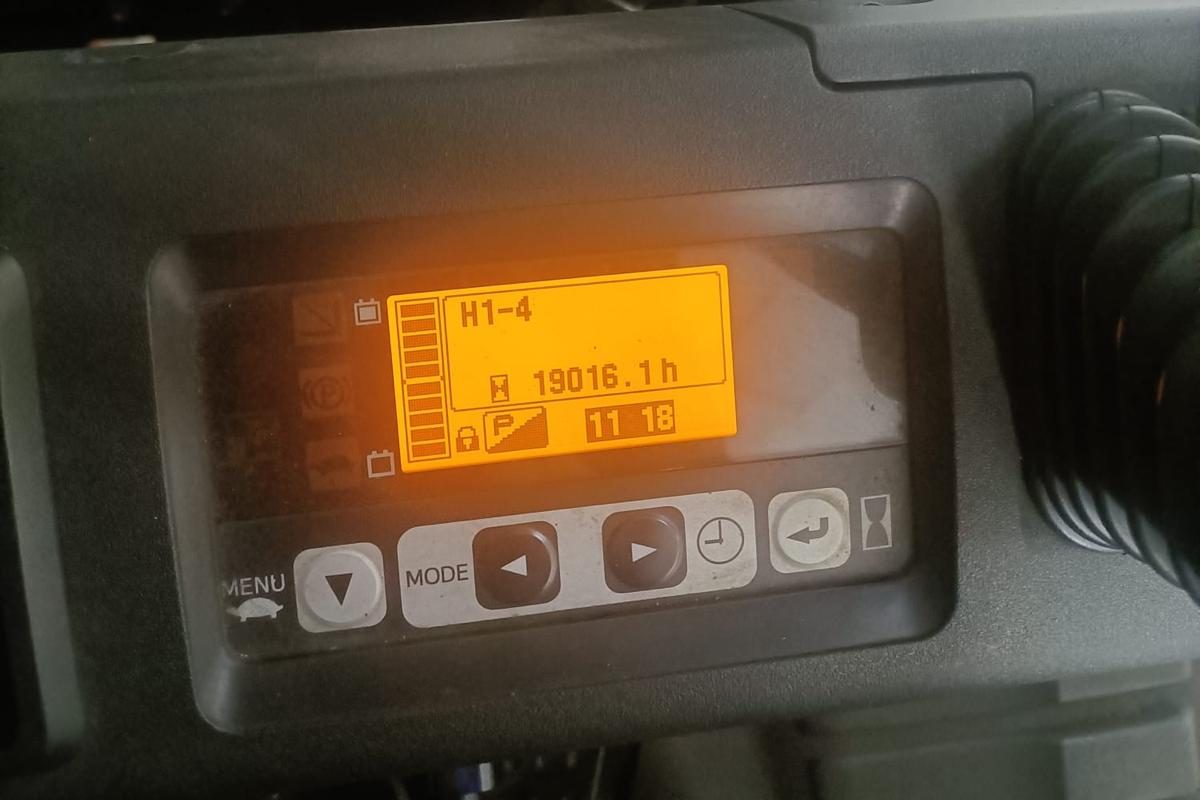
A modern truck tells you what is wrong, in its own dialect. The same code means different things on different brands, and on some machines the number on the display is not the number in the service literature at all — a Jungheinrich truck will show a four-digit event message that has to be translated before it means anything.
M&C keeps a private fault-code library of 4,460 records covering seven brands, of which 1,417 are Jungheinrich. It is used by our own technicians and is not published. The practical point for you is the test, not our library: read the code off your display and ask whoever is quoting to tell you what it means before they come. A company that has serviced your brand before will answer in a minute.
3. Do they hold the manual for your model?
Torque figures, service intervals, hydraulic pressures and wear limits differ between models within the same brand, never mind between brands. A workshop working from general experience rather than the manual for your exact machine will get most jobs right and the occasional expensive one wrong.
What MOM actually requires — and the trap
People often assume a forklift needs a certificate from an Authorised Examiner, like a crane. For ordinary forklift work, it does not.
MOM's Circular on Test and Examination Requirements for Statutory Lifting Equipment (MOM/OSHD/2025-05), dated 29 August 2025 and in effect from 12 September 2025, sets out which equipment must be tested and examined and by whom. The statutory lifting equipment it covers is lifts, hoists, lifting machines such as tower cranes, fixed cranes, mobile cranes and piling machines, lifting platforms, lifting appliances and lifting gears. A forklift doing ordinary forklift work — loading and unloading goods on its forks — is not on that list.
That circular also made three changes worth knowing if you have other lifting equipment on site: periodic overload tests after registration were removed, hoist examinations moved from every 6 months to every 12, and periodic re-examination of lifting gear may now be done by competent persons appointed by the occupier rather than only by an Authorised Examiner.
None of this removes the ordinary duty to keep the machine in safe working order, or the operator training requirements that tighten from 1 January 2027 — see forklift refresher training.
Six questions to ask before you sign
- Do you hold the parts catalogue and manual for my exact model? Not the brand. The model.
- Are your technicians employed by you, or subcontracted? Subcontracting is not automatically bad, but you should know who is turning up.
- Is there a call-out fee? Get it in writing. It is where surprise costs live.
- What is your response time? A number, not "as soon as possible".
- Do I get a written report with photographs after every visit? Without one you cannot prove maintenance happened, to MOM or to a buyer. See what a service report should contain.
- What does it cost per truck per year? Per-visit pricing hides the annual number, which is the one your budget cares about.
What it costs
M&C charges $80 per service visit with no call-out fee. A preventive maintenance contract works out at roughly $160 to $240 per truck per year, depending on how hard the truck works and how many visits it needs. Parts and consumables are quoted before the work is done, never after.
For the full breakdown of what a year of ownership costs, see forklift servicing cost in Singapore.
Who we are
M&C Industrial Solution Pte Ltd, UEN 202416056H, bizSAFE 3 certified, yard at 7 Gul Circle. We run a rental fleet of about 210 trucks and maintain roughly 300 customer-owned trucks under service contract, from our own workshop with our own technicians — not subcontracted. We are the officially appointed exclusive Zowell VNA agent in Singapore, and we are independent of every other brand we service, which is the point of this article.
Sources
- Ministry of Manpower, Circular on Test and Examination Requirements for Statutory Lifting Equipment (MOM/OSHD/2025-05), 29 August 2025, in effect 12 September 2025. Read 10 September 2026. The statutory lifting equipment table and the three changes quoted above are taken from this document.
- Ministry of Manpower, Circular: Safe Use of Excavators/Forklifts as Lifting Machines (MOM/OSHD/2022-02), 28 September 2022.
- M&C Industrial Solution Pte Ltd — parts catalogue, fault-code library and fleet figures, counted from our own systems on 10 September 2026.
Related
- Forklift servicing and repair: what we cover and how contracts work.
- Forklift not working? What to check before you call anyone.
- Forklift maintenance checklist: the free PDF your operators can use daily.
- What MOM looks at when it inspects your forklift.
Not sure anyone will take on your truck?
Send us the make, model and the code on the display. We will tell you whether we hold the manual and the parts for it before you commit to anything.
WhatsApp +65 9349 1314 Get a Free Quote