
What Does Forklift Servicing Cost in Singapore?
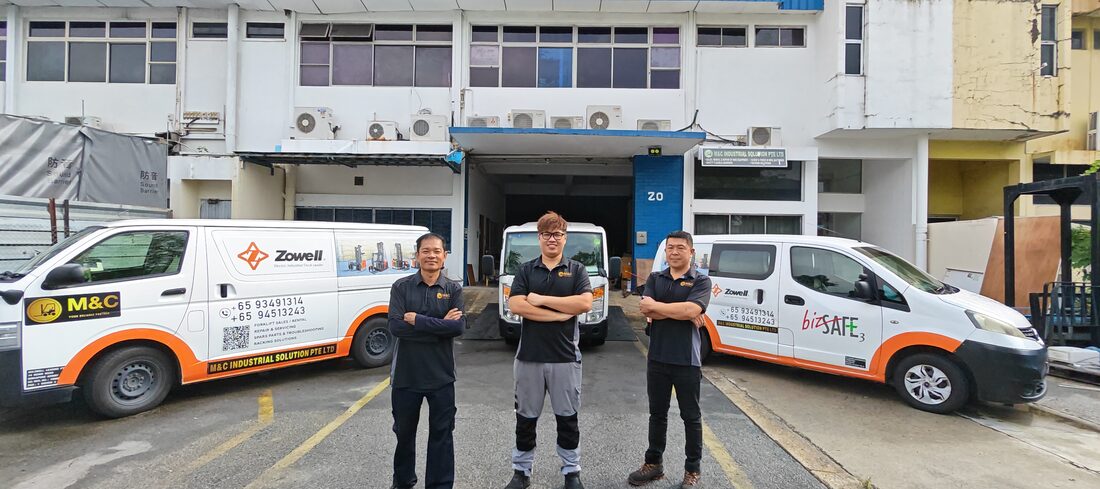
Preventive maintenance starts from $80 a visit — and "from" is doing real work in that sentence. The rate is quoted per truck, because a 1.5 tonne electric pallet stacker and a 7 tonne diesel counterbalance are not the same job. What decides your yearly bill is the rate for your trucks, how often they are visited, and what gets replaced along the way.
We will not quote you a figure off a web page. Send the brand, model and hour meter and you get a real number for your own trucks.
How often does a truck need servicing?
In practice we quote quarterly — four planned visits a year. That suits most Singapore warehouse operations and it makes the cost predictable, which is usually what a customer actually wants.
Behind that sits the engineering answer, which is that forklifts wear by use rather than by calendar. The 200 to 250 hour interval below is the manufacturers' figure for diesel trucks — electric trucks and warehouse equipment follow their own schedules, so treat this as the shape of it rather than as your truck's number:
| Trigger | Roughly | What gets done |
|---|---|---|
| Every 200 to 250 hours (diesel) | 4 to 6 weeks, single shift | PM service: fluids and filters, brakes, mast and chains, tyres, safety devices |
| Every 500 to 1,000 hours | 3 to 6 months | Hydraulic system, drive train, steering, electrical connections |
| Every 2,000 hours or yearly | Annual | Major service and overhaul items per the manufacturer's book |
| Every 6 months minimum | Low-hour trucks | Seals dry out and fluids degrade even when a truck barely moves |
What that means in practice. A truck running a normal single shift does roughly 1,000 to 1,500 hours a year, which is why quarterly visits suit most warehouses. A truck working two or three shifts needs more than four, and that is a conversation about your operation rather than a number off a page.
And the last row is the one people argue with: a truck that hardly gets used still needs servicing twice a year. Seals dry, fluids degrade and batteries suffer whether the machine is working or standing.
What is in the visit, and what is not
| In the PM visit | Charged separately |
|---|---|
| The technician's time and travel | Parts — filters, oil, brake components, wear items |
| The scheduled checks and adjustments | Tyres, when they reach the wear line |
| The service report and the record | Hydraulic hoses, when one goes |
| Telling you what is about to need doing | Battery replacement on an electric truck |
Nobody can quote you a yearly all-in figure honestly without knowing the truck, because the parts half depends on age, hours and how hard it works. What we can tell you is that the visit price is the predictable part and the parts are the part worth planning for.
Where the money actually goes
Across the trucks we look after, the spend clusters in the same few places:
- The battery, on an electric truck. This is the big one and it is almost always a maintenance failure rather than an age failure. A lead-acid traction battery has a working life of around five years or 1,500 charge cycles — but watering it wrongly, or charging it in short bursts, will take years off that. Replacing one is a large, avoidable bill.
- Tyres. Cheap to replace on schedule, expensive to ignore. Running past the wear line damages the rim and the drive.
- Hydraulic hoses. A hose that bursts is a mess, a stopped truck and an urgent call-out. A hose changed during a PM visit is a part and ten minutes.
- Chains and the mast. Chains stretch. Stretched chains wear sprockets, and by then it is not a chain job any more.
Every one of those is cheaper on a planned visit than on a breakdown, because the part is the same part — you are only choosing whether it gets replaced before or after it fails, and whether the truck stops on your schedule or on its own.
Planned servicing versus waiting for the breakdown
We are a servicing company, so treat this as a claim to check rather than a fact to accept. Here is the honest comparison:
| PM contract | Breakdown only | |
|---|---|---|
| Cost per year | Known in advance | Unknown until it happens |
| When the truck stops | When you booked it | When it decides |
| Parts | Replaced before failure | Replaced after — plus whatever the failure damaged |
| Records for an inspection | Complete | Whatever you can find |
| Attention | Booked | Whoever is free |
The row that costs the most is not the money row. It is the one about when the truck stops. A PM visit is arranged for a quiet morning. A breakdown happens on the day the container is waiting.
The part that is not optional
Under the Workplace Safety and Health Act, machinery must be kept safe and properly maintained, and records kept. That last clause is the one warehouses forget until somebody asks for them.
A servicing record that shows a truck was looked after — rather than repaired each time it failed — is one of the things behind any forklift inspection. We set out the rest in what MOM looks at when it inspects your forklift.
Three ways people spend more than they need to
- Servicing by the calendar instead of the hour meter. A truck doing two shifts on a "every six months" arrangement is running at three times the interval it should. A truck doing almost nothing on a monthly visit is paying for attention it does not need. Write the hour meter reading down. It is your servicing clock.
- Letting the battery look after itself. Topping up before charging instead of after, or opportunity-charging a lead-acid battery in short bursts, shortens its life by years. It is the most expensive habit in a warehouse and it costs nothing to correct.
- Waiting until two operators complain. If two people report the same niggle, that is not a niggle. It is a fault that has not stopped the truck yet.
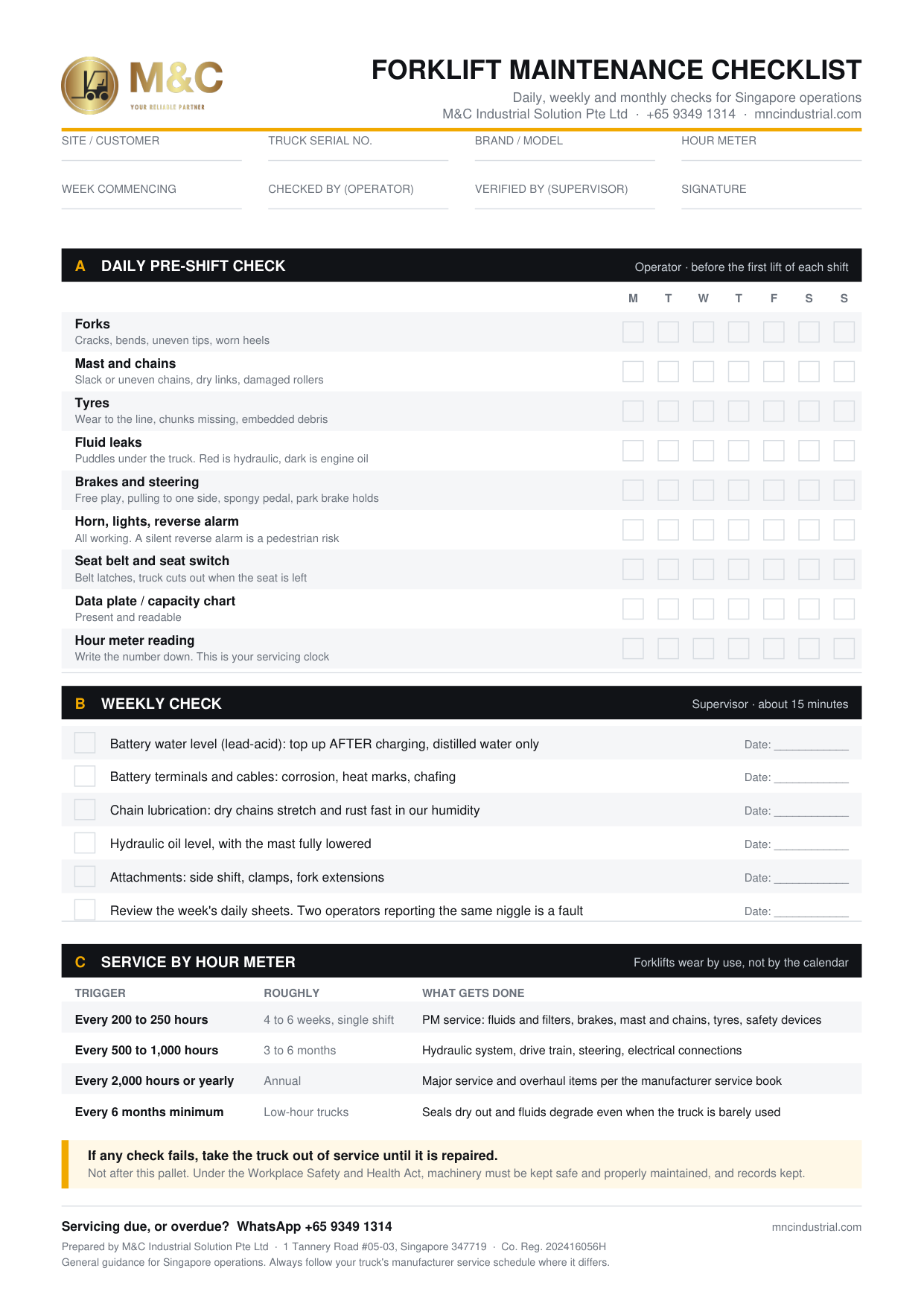 Download the PDF checklist
It has the hour-meter intervals on it, and a line for writing the reading down. That reading is what decides when the next service is actually due.
What to send us for a straight answer
We can price servicing properly from four things, without visiting:
- Brand, model and the hour meter reading on each truck
- How many shifts they run
- Indoor or outdoor, and what the floor is like
- When each was last serviced, if you know
Send those and we will tell you what the year looks like, and say plainly when a truck is old enough that servicing it is no longer the sensible answer.
And if the truck has already stopped
This page is about planned work. If a truck is down right now, start with what to check before you call anyone — a fair share of call-outs turn out to be a connector or a seat switch.
Common Questions
How much does forklift servicing cost in Singapore?
Preventive maintenance starts from $80 a visit, and the rate is quoted per truck - a small electric pallet stacker and a 7 tonne diesel counterbalance are not the same job. M&C normally quotes quarterly servicing, so four planned visits a year, which suits most Singapore warehouse operations and makes the cost predictable. Parts, tyres, hydraulic hoses and battery replacement are charged separately, because they depend on the age and hours of the truck rather than on the visit. For a real figure, send the brand, model and hour meter of each truck.
How often should a forklift be serviced?
In practice M&C quotes quarterly servicing - four planned visits a year - which suits most Singapore warehouse operations. Behind that sits the engineering answer: forklifts wear by use rather than by calendar, and the 200 to 250 hour interval usually quoted is the manufacturers' figure for DIESEL trucks. Electric trucks and warehouse equipment follow their own schedules. A truck working two or three shifts needs more than four visits a year. A truck that is barely used still needs servicing at least every six months, because seals dry out and fluids degrade whether the machine works or stands.
What is included in a forklift PM visit?
The technician's time and travel, the scheduled checks and adjustments, the service report and record, and being told what is about to need doing. Parts are charged separately: filters, oil, brake components, wear items, tyres when they reach the wear line, hydraulic hoses, and battery replacement on an electric truck.
Is a PM contract cheaper than paying for breakdowns?
Usually, and for a reason that is not really about the visit price. The parts are the same parts either way. On a planned visit they are replaced before they fail. On a breakdown they are replaced after, along with whatever the failure damaged, plus the call-out and the downtime. The bigger difference is control: a PM visit happens on a quiet morning, a breakdown happens on the day the container is waiting.
Where does most forklift maintenance money go?
On an electric truck, the battery, and it is usually a maintenance failure rather than an age failure. A lead-acid traction battery should last around five years or 1,500 charge cycles, but watering it at the wrong time or charging in short bursts takes years off that. After the battery: tyres, hydraulic hoses and mast chains.
Do I legally need to service my forklift in Singapore?
Under the Workplace Safety and Health Act, machinery must be kept safe and properly maintained, and records kept. The record-keeping half is the part most warehouses overlook until somebody asks to see it. A servicing history showing a truck was maintained, rather than repaired each time it failed, is one of the things behind any forklift inspection.
Send us the four numbers
Aisle width, height to the lowest obstruction, heaviest pallet, and whether the floor has been patched. We will tell you what fits before anyone visits.
WhatsApp us