Forklift Tyre & Load Wheel Replacement Singapore
Worn forklift tyres and load wheels measured, identified and replaced — all brands, all tyre types. WhatsApp us the truck details and a photo, and we will tell you what you need.
A worn forklift tyre does not usually fail all at once. It goes off gradually — the truck starts riding rougher, steering gets heavier, and someone finally reports it. By the time it gets reported, the operator has already been compensating for weeks.
We do not go by how a tyre looks. We measure it.
We measure, we do not guess
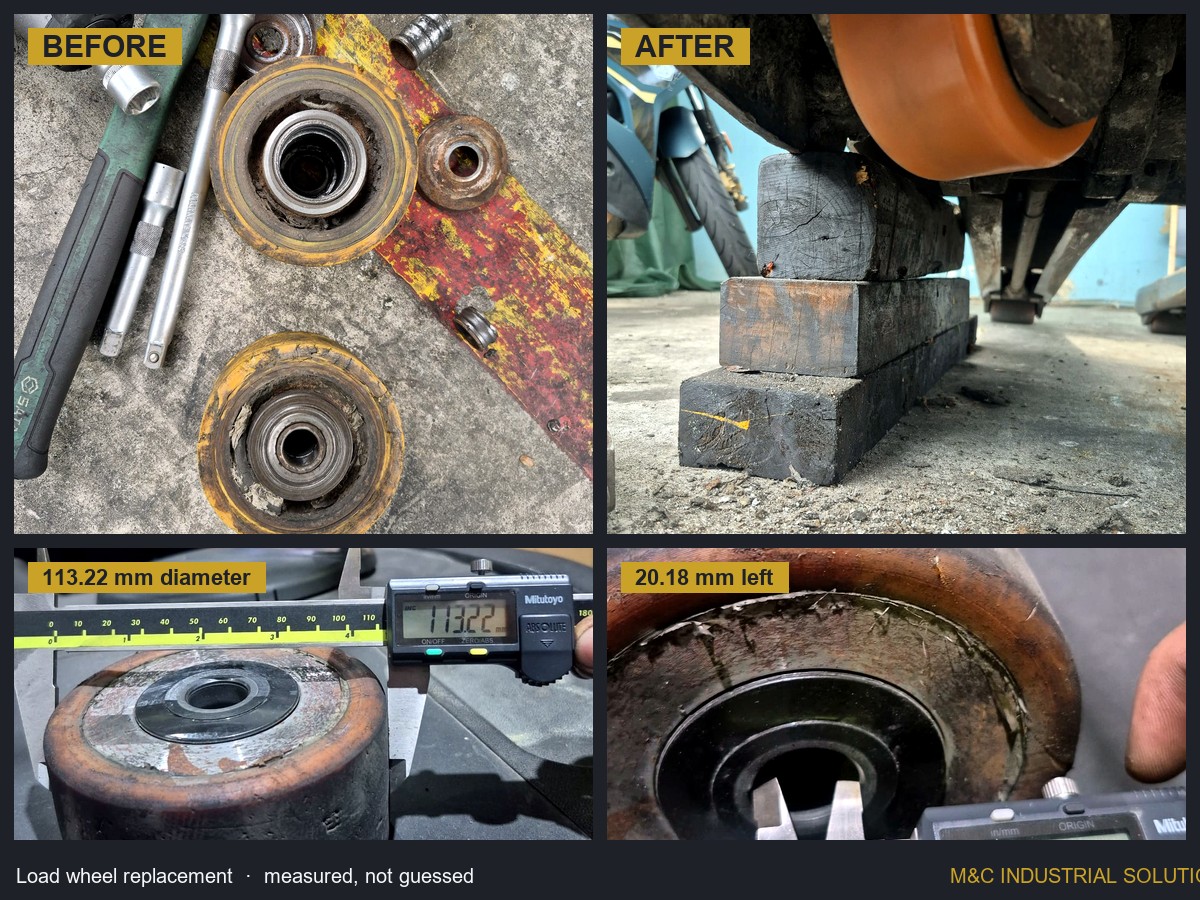
On a job this week, we put a digital caliper across a worn front load wheel: 113.22 mm. New, that wheel measures wider. What was left of the wearable material read 20.18 mm — thin enough that the truck was riding on the hub band, not the polyurethane. That is the number that decides whether a wheel gets changed today or watched for another month. Not a guess, not "it looks low" — a reading.
Every tyre and wheel job we do starts the same way: caliper on the part, number on the job sheet, decision made from the number. That is the whole method. It is not complicated. It is just measured instead of eyeballed, and most workshops skip the step because it takes an extra two minutes.
The three tyre types, in plain English
Solid (press-on / cushion) tyres. Rubber pressed onto a steel band, no air, no puncture risk. Standard on most electric counterbalance and reach trucks working on smooth warehouse floors. They wear from the outside in — you can usually see and measure the wear without removing the wheel.
Pneumatic and solid-pneumatic tyres. Air-filled or air-shaped rubber, used outdoors or on uneven yards where cushioning matters more than a small loss in stability. More common on IC (engine) counterbalance trucks working outside a warehouse.
Polyurethane load wheels. The small wheels under the forks and mast on reach trucks and pallet trucks, not the drive tyre. These take the direct weight of the load and wear fastest on trucks doing heavy pallet-in, pallet-out work all day. The wheel in the photo above is one of these.
None of the three is "better" — the truck and the floor decide which one it needs. A solid tyre on a rough outdoor yard wears unevenly and fast. A pneumatic tyre indoors loses stability it does not need to have. Match the tyre to where the truck actually works.
Why the size on the tyre is not enough on its own
This is the part most customers do not know, and most suppliers do not explain: a forklift's rated capacity does not tell you its tyre size. Two trucks from the same brand, same tonnage, can take completely different tyres depending on the model. We checked this against our own fleet and found capacity-based sizing charts wrong on multiple trucks we own — different brands, different tonnage classes, all mismatched against what a standard sizing guide would have ordered. A sizing chart is a starting guess, not a spec.
There is also more to a wheel than the size printed on it. The rim the tyre sits on is part of the part — same brand, same tonnage, different rim design, and a size number alone does not tell you which one you have. Many wheels also use a clip or lock ring to hold the tyre to the rim, and that clip comes in versions that are not interchangeable with each other.
Order against size alone and there is a real chance it is the wrong part. That means the truck goes down twice — once for the wrong part to arrive, once more for the right one — instead of once. The wasted round trip is usually worse for you than the part itself.
What to have ready before you call us
The fastest way to get the right part the first time is to give us what is actually on the truck, not what you think the truck should take. Before you WhatsApp or call, get:
- The data plate — a photo of the plate on the truck (usually near the operator seat or on the chassis). It carries the model and serial number, which is the most reliable way to identify the truck.
- The size moulded into the tyre or wheel itself, if it is still readable.
- A photo of the worn tyre or wheel, ideally next to a ruler or tape measure.
- The truck's brand and model, and roughly how the truck is used — indoor smooth floor, outdoor yard, or heavy pallet-handling all day.
With those four things we can usually identify the correct part without a site visit. If the size is unclear or the rim looks non-standard, we measure it in person before we order anything.
What M&C does
We measure the wear, identify the correct tyre or wheel against the data plate and what is actually fitted — not a capacity chart — and supply and fit it. We work across all brands in a Singapore fleet: BYD, Toyota, Linde, Crown, MiMA, Zowell and others. This applies whether the truck is one we rent to you, one we service under contract, or a truck you own outright that we have never touched before.
If you are not sure whether a wheel needs changing yet, send us the photo and the reading if you can get one. We would rather tell you it can wait than have you replace a tyre that had another few months left in it.
Regroove or replace?
We can regroove, and sometimes we will tell you not to bother. Regrooving cuts fresh tread into a tyre that still has enough rubber under the pattern to take it. On the right tyre it buys real extra life for very little money. On the wrong one it is a way of paying to keep a tyre that should already have come off.
| Regrooving makes sense when | Replace instead when |
|---|---|
| The tyre is marked as regroovable by the maker | There is no regroovable marking |
| There is enough rubber left below the pattern | The tyre is near or past the wear line |
| The carcass is sound — no cuts, chunks or embedded debris | There are chunks missing, cuts, or debris driven into the rubber |
| Grip is the problem, on a wet or smooth floor | The problem is ride, heat or the truck sitting low |
| The truck has a known job ahead and then goes off hire | The truck has years of work left in it |
The honest position: regrooving is a way of getting a bit more out of a tyre that is nearly done. It is not a substitute for replacing one that is finished, and cutting into a tyre without the rubber to spare weakens it. Tell us the tyre and what the floor is like and we will say which of the two you actually need.
Common Questions
How do I know when a forklift tyre needs replacing?
Measure it rather than judge it by eye. Solid and cushion tyres carry a wear line, and once the rubber reaches it the tyre is finished. M&C Industrial Solution measures tread depth and wheel diameter with a caliper before recommending a replacement, so the decision is measured rather than guessed.
Can I order a forklift tyre using the size printed on the sidewall?
Often not on its own. The same stated size can come in different profiles and hardness, and polyurethane load wheels in particular have to be matched on diameter and width together. Measuring the wheel is what stops a tyre arriving that will not fit.
What is the difference between solid, pneumatic and polyurethane forklift tyres?
Solid or press-on cushion tyres are rubber pressed onto a steel band, with no air and no puncture risk, and are standard on electric counterbalance and reach trucks on smooth warehouse floors. Pneumatic and solid-pneumatic tyres are air-filled or air-shaped, used outdoors or on uneven yards, and are more common on engine-powered counterbalance trucks. Polyurethane load wheels are the small wheels under the forks and mast on reach trucks and pallet trucks, and they wear fastest because they take the direct weight of the load.
Which forklift tyre type is best?
None of them is better in general. The truck and the floor decide it. A solid tyre on a rough outdoor yard wears unevenly and fast, and a pneumatic tyre indoors gives up stability it did not need to lose. Match the tyre to where the truck actually works.
Related reading
- Forklift servicing & repair: tyre wear is something a PM visit should be catching before it becomes a breakdown.
- Forklift rental: rental customers should know tyre condition is part of what we check.
- Reach trucks: load wheels are most relevant to reach trucks specifically.
Worn tyres or wheels?
WhatsApp us the truck details and a photo, and we will tell you what you need.
WhatsApp +65 9349 1314 Get a Free Quote