Forklift Attachments in Singapore: Why the Plate on Your Truck Is Now Wrong
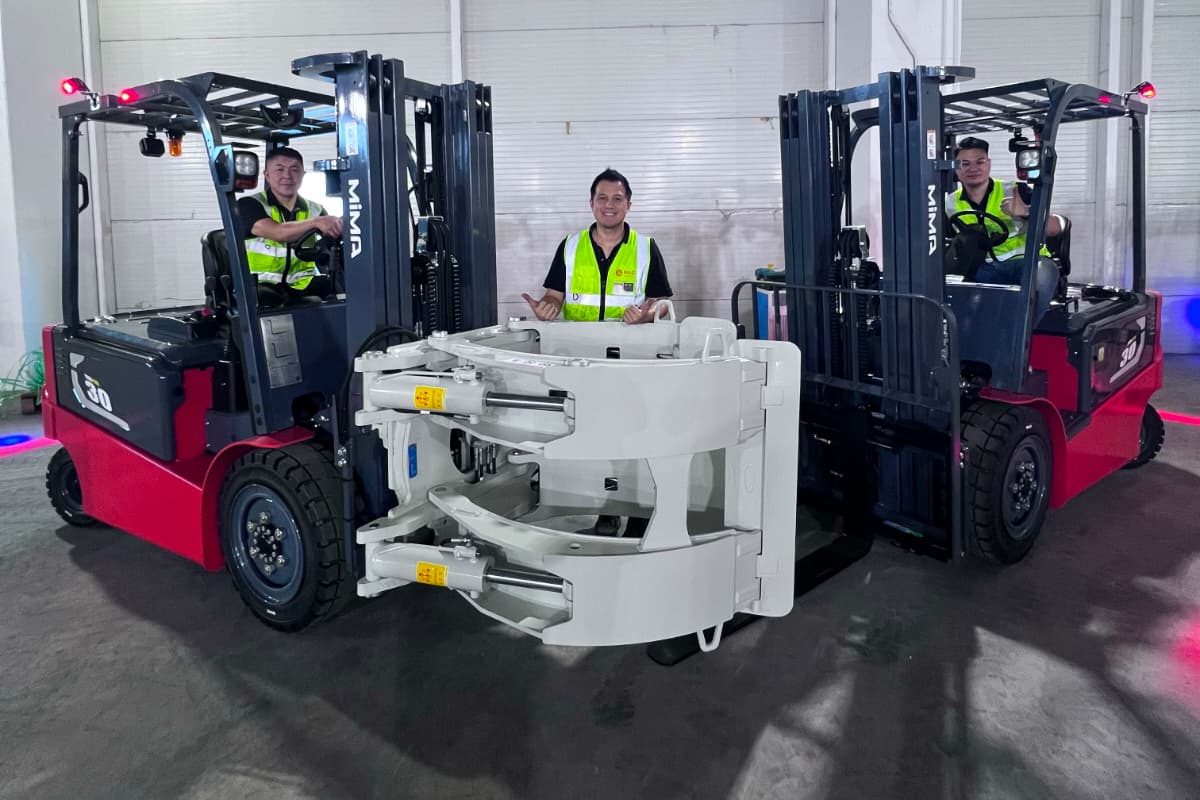
A paper roll clamp on a 3 tonne electric truck. The clamp weighs a great deal on its own and holds the load well forward of the carriage — which is exactly why the capacity plate that came with the truck no longer applies.
Bolt an attachment onto a forklift and you have changed the machine. Its rated capacity is no longer the number on the original plate, and in Singapore an attachment used for lifting has to be one the manufacturer or supplier has approved, with a load capacity chart to match. This is the area where we see the most confusion on customer sites, and it is also where MOM is least forgiving, because attachment failures hurt people.
What Singapore actually requires
When a forklift is used as a lifting machine — that is, lifting a suspended load rather than carrying a pallet on the forks — it falls under the WSH (Operation of Cranes) Regulations, and the requirements are specific:
- The machine must be fitted with an attachment or hook approved by the manufacturer or supplier, and a hook must have a safety catch.
- A load capacity chart from the manufacturer or supplier must be furnished for that combination of truck and attachment.
- Information from the manufacturer or supplier on the safe use of the machine with that attachment must be available.
- The safe working load must not exceed 5 tonnes when the forklift is used as a lifting machine.
Read that list again and notice what it does not say. It does not say the attachment must look suitable, or be strong enough, or have worked fine for two years. It says approved, with a chart, in writing, from the people who built it.
Why an attachment changes the capacity, and by how much
Two things happen the moment an attachment is fitted, and they both work against you:
- The attachment has weight of its own, and that weight hangs out in front of the front axle where it counts most against the counterweight.
- The load centre moves forward. A clamp or a rotator holds the load further from the carriage than forks would, and capacity falls sharply as the load centre moves out.
The result is that a truck rated at, say, 2.5 tonnes with standard forks may be well under 2 tonnes with a clamp fitted — and the figure is not one anybody should be estimating on site. It comes from the manufacturer, for that truck, with that attachment, at that mast height.
If the attachment lets the truck carry a suspended load, a further set of MOM rules applies — see slinging a load from forklift forks.
The attachments that need this most
| Attachment | What it is used for | Why it needs approval |
|---|---|---|
| Jib or crane arm | Lifting a suspended load from a hook | Turns a forklift into a lifting machine. Full Operation of Cranes requirements apply |
| Clamp (paper, carton, bale, drum) | Gripping loads without a pallet | Heavy, and holds the load well forward. Large capacity reduction |
| Rotator | Tipping or inverting a load | Adds weight and length, and the load moves during the cycle |
| Fork extensions / slippers | Handling longer loads | Move the load centre a long way out. Often fitted with no paperwork at all |
| Side shift, fork positioner | Alignment without repositioning the truck | Usually factory-fitted, but still changes the rated figure |
| Man cage / work platform | Lifting a person | A separate and much stricter question. Never improvise this one |
Where companies get caught
- An attachment bought separately from the truck. It fits mechanically, so everyone assumes it is fine. Nobody asked the truck manufacturer whether it is approved for that model, and nobody has a chart.
- An attachment moved from an old truck to a new one. Approval is for a combination, not for a part. The same clamp on a different truck is a different question.
- Fork extensions kept in the corner "for when we need them". These are the most common uncontrolled attachment in Singapore warehouses, and the easiest to use without thinking.
- A workshop-made bracket. Fabricated locally, welded neatly, entirely undocumented. There is no route to compliance for this after the fact.
- Nobody can find the paperwork. The approval may well exist. If it cannot be produced on the day, it does not help you.
What we do about it
This is the part customers find hardest, because it means dealing with the factory, and often a factory overseas in a different language and time zone.
M&C handles that for you. We supply forklifts across several brands and we deal with those manufacturers routinely, so:
- We check whether an attachment is approved for your exact truck before anything is fitted, rather than after.
- We obtain the manufacturer's load capacity chart for that truck and attachment combination.
- We arrange the revised capacity plate so the number on the machine matches the machine as it now stands.
- We keep the documents on the truck's record, so when somebody asks for them, they exist.
- If an attachment you already own cannot be approved, we will tell you that plainly rather than fitting it and staying quiet.
And if you are renting from us, this sits with us as a matter of course. A rented truck arrives with the right plate for the configuration it arrives in.
What to check on your own fleet this week
- Walk the fleet and note every truck with anything other than plain forks. Include the extensions in the corner.
- For each one, ask for the load capacity chart covering that truck with that attachment. Not the truck's original plate. The combination.
- Look at the plate on the machine itself and ask whether it reflects what is fitted today.
- Ask your operators what capacity they think they have. If the answer is the number on the original plate and there is a clamp fitted, you have found the problem.
Send us the truck model and a photo of the attachment and the plate, and we will tell you where you stand before anybody else asks.
Common Questions
Do forklift attachments need manufacturer approval in Singapore?
Yes. When a forklift is used as a lifting machine it must be fitted with an attachment or hook approved by the manufacturer or supplier, a hook must have a safety catch, and a load capacity chart from the manufacturer or supplier must be furnished for that truck and attachment. Information from the manufacturer on safe use must also be available. Forklifts used for lifting suspended loads fall under the WSH (Operation of Cranes) Regulations.
Does an attachment reduce a forklift's capacity?
Almost always, and often by more than people expect. The attachment has weight of its own hanging forward of the front axle, and it usually holds the load further from the carriage than plain forks would. Both effects cut the safe load. A truck rated at 2.5 tonnes on forks can be well under 2 tonnes with a clamp fitted. The correct figure comes from the manufacturer for that exact combination, not from an estimate on site.
Do I need a new capacity plate after fitting an attachment?
The truck needs to display a rated capacity that reflects how it is actually configured. The original plate describes the truck as it left the factory, so once a clamp, jib, rotator or set of extensions is fitted, that plate no longer tells the operator the truth. Obtaining the revised figure and plate from the manufacturer is part of fitting the attachment properly.
Are fork extensions a problem?
They are the most common uncontrolled attachment we see in Singapore warehouses. They move the load centre a long way forward, they are easy to slide on without anybody deciding to, and they are frequently kept in a corner with no paperwork at all. Treat them as an attachment, not as an accessory.
What is the maximum load when a forklift is used for lifting?
The safe working load must not exceed 5 tonnes when a forklift is used as a lifting machine. That is on top of, not instead of, the requirement for an approved attachment and a manufacturer's load capacity chart.
Can M&C help with attachment approval?
Yes, and it is one of the things customers find hardest to do themselves because it means dealing with the factory, often overseas. We check whether an attachment is approved for your exact truck before it is fitted, obtain the manufacturer's load capacity chart for that combination, arrange the revised capacity plate, and keep the documents on the truck's record. If an attachment cannot be approved, we will say so rather than fitting it quietly.
Send us the four numbers
Aisle width, height to the lowest obstruction, heaviest pallet, and whether the floor has been patched. We will tell you what fits before anyone visits.
WhatsApp us